AGS Highlights Preclinical Data Supporting the Broad Immunomodulatory Potential of its Oral MEV Platform for Immunomodulation and Mucosal Vaccination
Microalgae-derived extracellular vesicles (MEVs) provide an integrated capacity to engage both innate and adaptive immune pathways during oral delivery of their payloads. Such capacity results in mucosal immune activation against antigenic payload that is not typically observed with conventional mucosal adjuvants or existing delivery systems, as well as effective innate immunomodulation driven by their encapsulated payloads, particularly when the payloads include Toll-like receptor (TLR) ligands.
Évry, France — AGS, a biotechnology company developing Microalgae Extracellular Vesicle (MEV)-based therapeutics, today announced preclinical data suggesting that its oral MEV platform enables efficient antigen delivery and coordinated engagement of mucosal and systemic immune responses following non-invasive administration, through integrated modulation of innate and adaptive immune pathways.
In a controlled in vivo study, orally administered MEVs loaded with a viral antigen model induced robust antigen-specific secretory IgA responses in intestinal samples, a functional readout associated with mucosal immune activation. These responses were observed at substantially low antigen doses in the absence of any external adjuvant.
These findings are consistent with a broader previous dataset indicating that orally delivered MEVs protect their payload through the gastrointestinal tract and are efficiently internalised by intestinal epithelial cells as well as immune cells within the gut-associated lymphoid tissue (GALT). Following uptake, MEVs appear to be processed by dendritic cells and macrophages and to traffic via GALT-resident antigen-presenting cells toward secondary lymphoid organs, including the spleen, without detectable systemic circulation of free cargo, suggesting a compartmentalized route of immune engagement.
Innate and Adaptive Immune Mechanisms
The immunological activity associated with MEVs is consistent with early engagement of innate immune sensing pathways. In particular, MEVs and their associated cargo may interact with pattern recognition receptors, including the endosomal Toll-like receptor 3 (TLR3) and Toll-like receptor 9 (TLR9), in epithelial cells and antigen-presenting cells. This is suggestive of an upstream innate immune sensing component that may contribute to downstream cytokine signalling, dendritic cell maturation, and the orchestration of adaptive immune responses.
In parallel, MEVs support efficient antigen presentation within mucosal immune compartments, leading to antigen-specific adaptive immune responses. The combined data would suggest a coordinated interplay between innate immune sensing and adaptive immune activation following oral MEV administration.
Delivery Efficiency and Cost-of-Goods Implications
The enhanced immunological efficiency of MEVs is further reflected in their ability to induce mucosal IgA responses at markedly low antigen doses. This improved antigen utilization suggests a potential reduction in cost of goods, as recombinant protein antigens remain among the most expensive components of subunit vaccine manufacturing. For oral vaccines intended for large-scale deployment, per-dose cost remains a key determinant of commercial feasibility and global accessibility.
Platform Differentiation
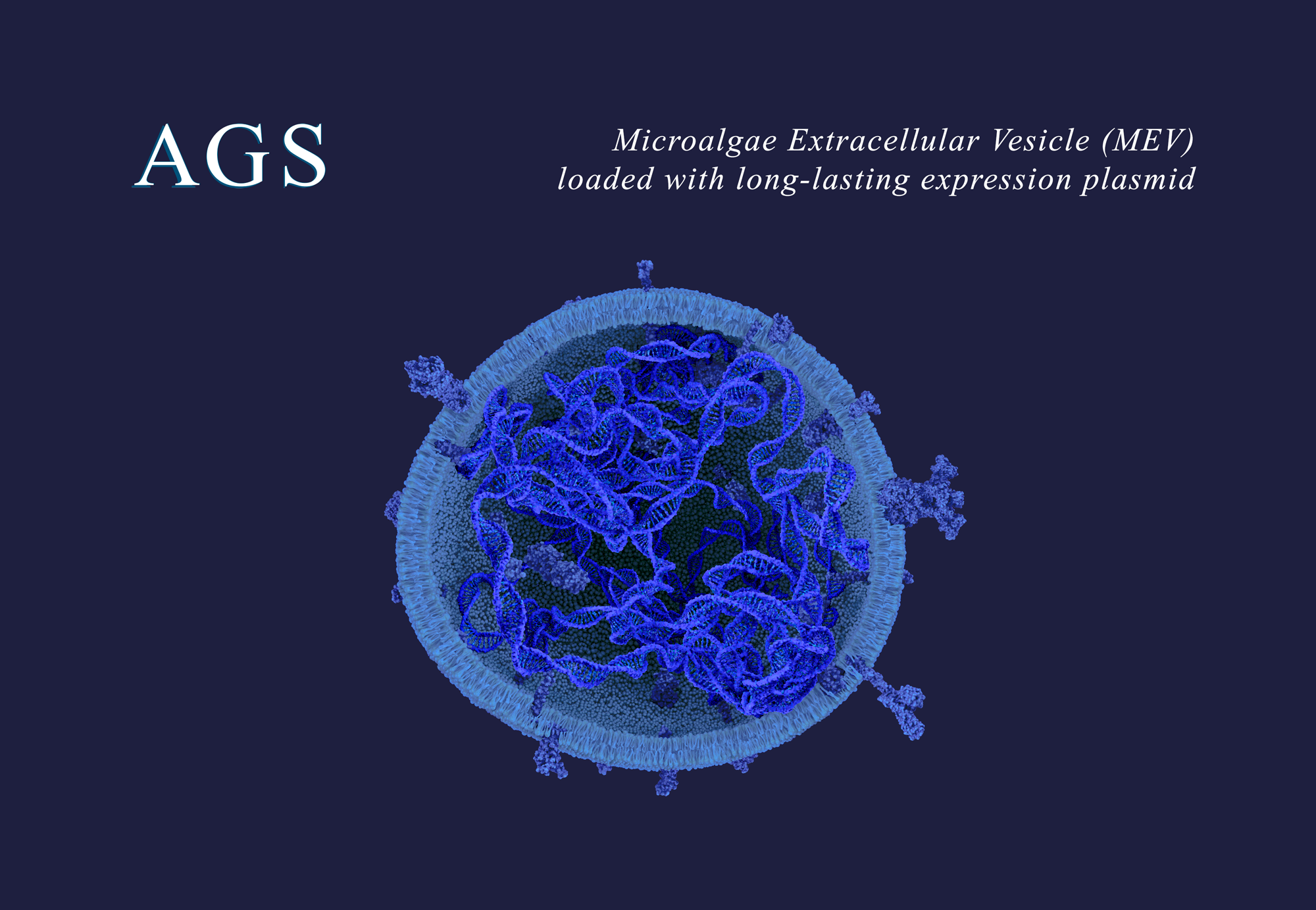
The MEV platform is structurally and functionally distinct from conventional delivery technologies. Derived from non-genetically modified Chlorella microalgae, MEVs are capable of encapsulating diverse therapeutic payloads, including proteins, peptides, mRNA, siRNA, dsRNA, oligonucleotides, and plasmid DNA. Unlike synthetic lipid nanoparticles, MEVs are intrinsically bioactive and retain native vesicular architecture, which may enable biologically contextual interactions with the mucosal immune environment.
Beyond their role as delivery vehicles, MEVs appear to participate in immune interface signalling. Available data suggest that MEVs may engage innate immune sensing pathways, including endosomal Toll-like receptor axes such as TLR3 and TLR9, potentially linking cargo delivery with innate immune activation. This integrated behaviour is not typically associated with conventional synthetic delivery systems, which generally function as passive carriers lacking intrinsic vesicle-associated immune signalling properties.
AGS has further demonstrated functional mRNA delivery to intestinal epithelial tissue following oral administration, suggesting that MEVs may enable biologically active nucleic acid delivery in the gastrointestinal environment, a capability not yet widely reported for comparable delivery modalities.
The company’s intellectual property portfolio comprises multiple patent families covering MEV manufacturing, loading technologies, payload modalities, and therapeutic applications, with protection extending into 2042–2046.
Broader Implications
Collectively, these findings support the positioning of AGS’ MEV platform as a differentiated oral biologics delivery and immunomodulation technology capable of engaging both innate immune sensing and adaptive immune effector pathways. The data suggest that MEVs may enable multi-layered immunomodulation across mucosal and systemic compartments, involving key immune cell populations such as dendritic cells and macrophages within the intestinal mucosa.
AGS is advancing the development and industrialization of its proprietary MEV technology as a next-generation biological asset-generation engine, designed to systematically produce a pipeline of differentiated therapeutic and immunomodulatory products across major disease areas, including inflammatory and autoimmune disorders, infectious diseases, metabolic conditions, and oncology, from a single scalable MEV framework. In this paradigm, MEVs are not positioned as a conventional delivery platform, but as a foundational technology for generating deployable biological assets with programmable immunological activity across multiple indications.
Within this framework, oral and inhaled MEV modalities are being developed in parallel as core product vectors rather than secondary applications. Oral MEVs are being advanced for systemic and mucosal immunomodulation through gastrointestinal delivery, while inhaled MEVs are being developed for respiratory applications where localized administration may enable precise tissue-level immunomodulatory control and disease-relevant immune reprogramming.
“We believe the MEV platform has the potential to become an important technological foundation for companies seeking novel and cost-effective approaches in immunomodulation and immune reprogramming, as well as in vaccination” added Marie-Hélène Leopold, Chief Corporate Development Officer at AGS. “The combination of oral administration, targeted immune cell interaction, and extracellular vesicle biology offers a differentiated framework for future therapeutic and vaccinal innovation.”
About AGS
AGS is a biotechnology company based in Évry, France, focused on the development of proprietary Microalgae Extracellular Vesicle (MEV)-based technologies for therapeutic and biopharmaceutical applications. The company is developing a next-generation MEV platform centred on oral biologic delivery, mucosal immunomodulation, extracellular vesicle-based therapeutics, and immune cell targeting technologies.
Forward looking statement
This announcement may include predictions, estimates or other information that might be considered forward-looking. While these forward-looking statements represent our current judgment on what the future holds, they are subject to risks and uncertainties that could cause actual results to differ materially. The reader is cautioned not to place undue reliance on these forward-looking statements, which reflect our opinions only as of the date of this communication.
Contacts
Marie-Hélène Leopold | AGS Therapeutics | +33 (0)6 07 16 55 01 | mhl@ags-tx.com
Ana Vega | Markets & Listing | +33 (0)6 88 57 05 77 | av@markets-listing.com